
Brent Above $108: Saudi Pipeline, Fed Hike Odds, AI Doubts
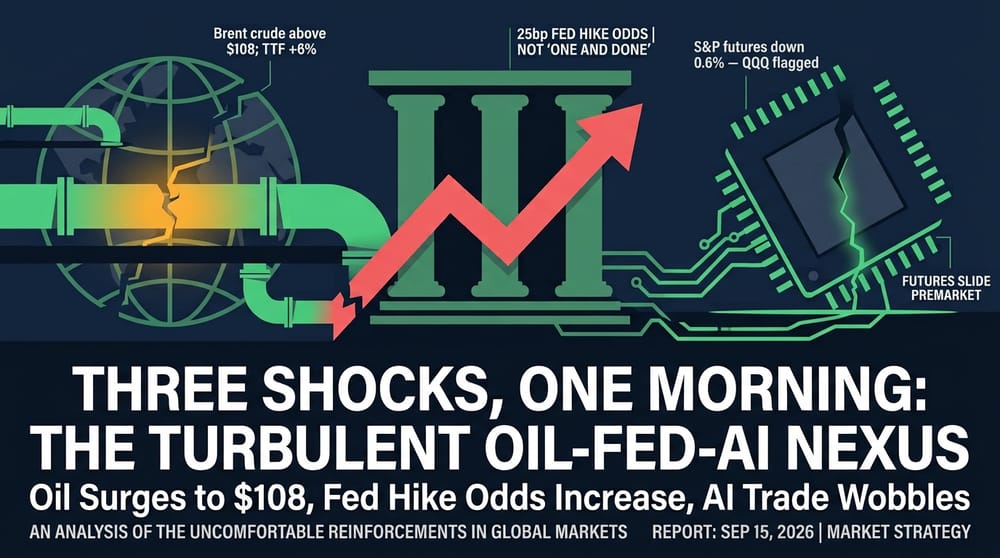
Three Shocks, One Morning: $108 Oil, Fed Hike Odds, AI Trade Wobbles
Yesterday we flagged three converging risks. Overnight, they escalated.Brent crude is trading above $108. European natural gas posted its highest print since 2022. And Morgan Stanley says the bond market is telling the Federal Reserve it needs to hike again — on Wednesday. Within a few hours on Sep 14, three separate narratives moved from background noise to front-page risk. Here is what actually happened, and what it means for positioning.
---
1. Saudi East-West pipeline halted: roughly 4% of global supply at risk
What happened. A drone attack halted Saudi Arabia's East-West pipeline, putting approximately 4% of global crude supply at risk, according to ZeroHedge (Sep 14). Brent broke above $108. Bernstein warned crude could reach $150 (ZeroHedge, Sep 14). In Europe, TTF natural gas jumped 6% in a single session, its highest level since 2022 (ZeroHedge, Sep 14).
Why it matters. This is a supply-side energy shock arriving right as winter demand risk builds in Europe. Two transmission channels open at once: headline inflation pressure through refined products and power, and a real physical constraint if the outage extends. The 4% supply figure is the number to anchor on — it is large enough to matter for global balances, not merely a sentiment story. Bernstein's $150 scenario is a scenario, not a forecast — an upside tail rather than a base case.
Affected assets. Energy-linked equities and commodities carry the most direct sensitivity, though at $108 Brent much of the initial move may already be reflected. European utilities and gas-exposed industrials face margin pressure if TTF holds these levels. For holders of broad equity exposure, the relevant question shifts from growth to input costs: if energy stays elevated into winter, the disinflation assumption embedded in duration-sensitive assets looks more fragile. The pipeline restart timeline is the key variable in the coming sessions.
2. Morgan Stanley expects a 25bp Fed hike on Wednesday
What happened. Morgan Stanley global head of macro strategy Hornbach said the bond market is making it clear the Fed needs to hike, and expects a 25 basis point increase at Wednesday's meeting (Bloomberg, Sep 14). Importantly, Hornbach added that the market has not priced a "one and done" outcome — meaning participants are not positioned for a single hike that ends the cycle (Bloomberg, Sep 14).
Why it matters. A hike scheduled for Wednesday has not yet taken effect. The signal here is about pricing, not policy that is already in force. If a hike lands on Wednesday and energy prices remain elevated — as described in the pipeline story above — the combination compresses the case for duration and for long-duration equity multiples simultaneously. The "one and done" detail is the sharper point: two-sided risk around the path matters more than the single decision.
Affected assets. Rate-sensitive fixed income faces duration risk if the hike is delivered alongside hawkish guidance. Growth and long-duration equity exposure typically carries the highest multiple sensitivity to real yields, so the risk-reward in that cohort looks less favorable if the front end reprices higher. For currency and gold, the statement language may matter more than the headline decision itself.
---
3. AI slowdown fears hit tech; S&P futures down 0.6%
What happened. Concerns about the pace of AI development drove a tech-led selloff, with S&P futures down 0.6% premarket (ZeroHedge, Sep 14). Oil moved higher, but bond yields had not yet responded (ZeroHedge, Sep 14). Marginal flow rotated toward crypto assets (ZeroHedge, Sep 14). QQQ was the ticker flagged in the source material.
Why it matters. The AI capex and adoption narrative has been the single largest support for mega-cap tech valuations. When that narrative cools even modestly, the valuation risk becomes concentrated and reflexive — the same names that lifted the index become the drag. The detail that yields had not yet reacted is worth flagging: it suggests this leg of the selling is narrative-driven, not rates-driven. If yields do catch up to oil later, tech faces a second, harder test.
Affected assets. QQQ and AI-adjacent supply chain names carry the clearest exposure to a narrative re-rating. The rotation into crypto, as described, suggests some capital is seeking beta outside traditional tech — that flow can reverse quickly if AI sentiment stabilizes. Until there is clearer evidence on AI demand timelines, the risk-reward for crowded AI positions appears unfavorable on a valuation basis.
The thread connecting all three
A supply shock, a potentially hawkish Fed, and a leadership group losing its narrative is an uncomfortable combination because the three reinforce each other. Energy feeds inflation, inflation feeds the hike case, and the hike case pressures the exact valuations the AI trade depends on. None of these are certainties. The pipeline could restart. The Fed could deliver a hike with dovish guidance. AI sentiment could stabilize within days. But the burden of proof has shifted toward the bulls on all three fronts at once.
---
Sources:
1. ZeroHedge — "Oil Surges As Saudi Pipeline Crisis Puts 4% Of Global Supply At Risk; Bernstein Warns Of $150 Crude" (Sep 14). https://www.zerohedge.com/energy/oil-surges-saudi-pipeline-crisis-puts-4-global-supply-risk-bernstein-warns-150-crude
2. Bloomberg — "Bonds Making It Clear the Fed Needs to Hike, Morgan Stanley’s Hornbach Says" (Sep 14). https://www.bloomberg.com/news/videos/2026-09-14/bonds-making-it-clear-the-fed-needs-to-hike-hornbach-video
3. ZeroHedge — "Futures Slide As Tech Tumbles On Fears Of AI Slowdown, Oil Jumps" (Sep 14). https://www.zerohedge.com/markets/futures-slide-tech-tumbles-fears-ai-slowdown-oil-jumps
This article was drafted with AI assistance and reviewed by the Yocobe editorial team.
Disclaimer: For informational and educational purposes only. Not investment advice. Past performance does not indicate future results. The author may hold positions in securities mentioned. Verify all data with primary sources before making any decision.
---
