
Brent Back Above 100, Yields Near 5%: Three Risks Converging
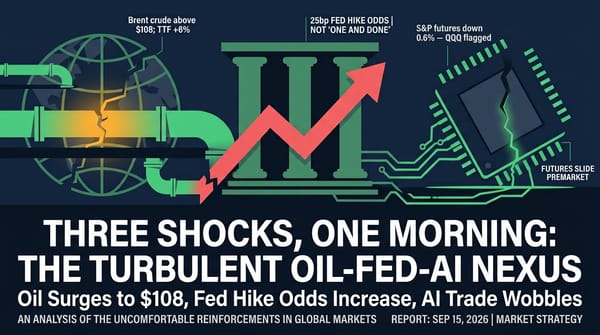
Three numbers are doing the talking this week: crude pushing toward $110, a key Treasury yield flirting with 5%, and SoftBank down as much as 13% in a single session. None of them fits comfortably with the view that the second half of 2026 is a clean disinflation, rate-cut story. Here is what happened, why it matters, and which assets sit closest to the pressure points.
1. The Fed is back in the hike conversation
What happened. The Federal Reserve issued an FOMC statement on Jul 29, 2026, with inflation running above expectations (Federal Reserve, Jul 29, 2026). Since then, the sell-side has moved: Goldman Sachs withdrew its no-hike forecast — the last major bank to shift toward expecting a hike — and bets on a move next week have been rising (CoinDesk, Sep 13). The same report carries an economist arguing the case for hiking is about Wall Street rather than inflation (CoinDesk, Sep 13). At the same time, a bond selloff has pushed a key Treasury yield toward 5%, lifting borrowing costs and deepening concern in Washington and on Wall Street about the economic outlook (Bloomberg, Sep 13).
Why it matters. When the front end reprices toward a hike while the long end is already near 5%, the curve is telling two stories at once: near-term inflation risk and longer-run growth doubt. That combination tends to compress equity multiples through the discount rate rather than through earnings. It also elevates the Fed's next statement to the single largest scheduled event risk on the calendar.
Affected assets. Rate-sensitive sectors and long-duration growth names face a higher discount rate if front-end yields keep climbing; holders of those exposures have a policy decision, not a data point, as their next catalyst. A dollar that firms on hike expectations adds pressure on emerging-market importers and on dollar-priced commodities — though oil's own supply story, below, can overwhelm that channel.
2. Oil: attacks continue, diplomacy stumbles, Hormuz talks slide
What happened. Crude rose more than 3% at one point, approaching $110, as Middle East attacks continued and Gulf-Iran talks were postponed (OilPrice.com, as of latest reporting). A parallel report put Brent above $100 after Saudi Arabia shut a major crude pipeline alongside the Iran conflict — a combination that revived recession fears and raised Fed hike expectations (OilPrice.com, as of latest reporting). The Gulf-Iran shipping talks aimed at creating a temporary Strait of Hormuz channel were postponed (ZeroHedge, as of latest reporting). Separately, President Trump urged Zelenskyy to stop striking Russia's diesel refineries, while Ukraine said a passenger train bound for Warsaw was hit by a Russian drone near the Polish border (Bloomberg, Sep 13).
Why it matters. Energy is the input cost that reaches every other line item. An oil price near $110 lifts headline inflation, shipping and freight costs, and — if it persists — the odds the Fed feels obliged to tighten into a slowing economy. The stalled Hormuz talks matter because the strait is the chokepoint, not the barrel: risk there is a shipping and insurance story before it becomes a volume story.
Affected assets. WTI and Brent futures (CL=F and BZ=F) are the most direct expression (OilPrice.com, as of latest reporting). Downstream, transport, freight and consumer-facing margins carry fuel-cost sensitivity, while inflation-linked bonds and gold have historically been where capital looks when an energy shock meets a hawkish central bank. Should the talks resume and a channel be agreed, part of the geopolitical premium would be expected to deflate; current reporting does not indicate that is imminent (ZeroHedge, as of latest reporting).
3. The AI safety alarm lands on the AI supply chain
What happened. Executives at Anthropic and OpenAI called for slowing AI development, and SoftBank shares fell as much as 13%, with chip and supply chain stocks under pressure as the market questioned the pace of AI capital spending (Bloomberg, Sep 14). SoftBank (9984.T), Nvidia (NVDA) and TSMC (TSM) were among the names under pressure in the source report (Bloomberg, Sep 14).
Why it matters. AI equity valuations rest on a capex timeline. When the labs themselves — not regulators, not short-sellers — talk about slowing down, the market's question shifts from 'how big is the buildout' to 'how long does it run.' That is a duration question, and it arrives while the discount rate is already drifting higher.
Affected assets. Semiconductor and AI-adjacent supply chain names carry elevated expectations, so headline risk is asymmetric. If lab commentary on safety translates into slower deployment schedules, suppliers with concentrated AI revenue exposure face estimate risk; if it stays rhetorical, the drawdown looks more like positioning than fundamentals. Valuation sensitivity for richly valued AI supply chain exposure remains elevated until the capex guidance picture clarifies.For AI-heavy portfolios, the two pressures compound: a rising discount rate meets elevated capex-duration sensitivity across the AI supply chain. This week, the policy decision matters as much as any earnings print.
Also on the tape
Circle agreed to acquire Tazapay for $400 million, buying emerging-market payment links that 'take years to build' and extending USDC's reach into regions where Tether has traditionally been strongest (CoinDesk, Sep 13). It is a reminder that stablecoin distribution, not just issuance, is where the competitive spending is going.
---
Sources:
1. Federal Reserve — 'Federal Reserve issues FOMC statement' (Jul 29, 2026). https://www.federalreserve.gov/newsevents/pressreleases/monetary20260729a.htm
2. OilPrice.com — 'Oil Prices Surge as Middle East Attacks Continue and Diplomacy Stumbles' (as of latest reporting). https://oilprice.com/Energy/Energy-General/Oil-Prices-Surge-as-Middle-East-Attacks-Continue-and-Diplomacy-Stumbles.html
3. OilPrice.com — 'Further Oil Price Spikes Could Rekindle Recession Fears' (as of latest reporting). https://oilprice.com/Energy/Oil-Prices/Further-Oil-Price-Spikes-Could-Rekindle-Recession-Fears.html
4. ZeroHedge — 'Hormuz Deal Hits Snag: Monday's Gulf-Iran Shipping Talks Postponed' (as of latest reporting). https://www.zerohedge.com/geopolitical/uae-meets-iran-leaders-tehran-teases-oman-shipping-deal
5. Bloomberg — 'SoftBank Shares Slide 13% After AI Chiefs Sound Alarm on Safety' (Sep 14, 2026). https://www.bloomberg.com/news/articles/2026-09-14/softbank-group-shares-fall-after-openai-ipo-delay-ai-warning
6. Bloomberg — 'A 5% Treasury Yield Is Raising New Risks for Markets, Economy' (Sep 13, 2026). https://www.bloomberg.com/news/articles/2026-09-13/a-5-treasury-yield-is-raising-new-risks-for-markets-economy
7. CoinDesk — 'Fed rate hike is about Wall Street, not inflation, says economist' (Sep 13, 2026). https://www.coindesk.com/markets/2026/09/13/fed-rate-hike-is-about-wall-street-not-inflation-says-economist
8. Bloomberg — 'Trump Urges Zelenskyy to Stop Hitting Russia's Diesel Refineries' (Sep 13, 2026). https://www.bloomberg.com/news/articles/2026-09-13/trump-urges-zelenskyy-to-stop-hitting-russia-s-diesel-refineries
9. CoinDesk — 'Circle's $400M Tazapay deal buys emerging market links that take years to build' (Sep 13, 2026). https://www.coindesk.com/business/2026/09/13/circle-s-usd400m-tazapay-deal-buys-emerging-market-links-that-take-years-to-build
This article was drafted with AI assistance and reviewed by the Yocobe editorial team.
Disclaimer: For informational and educational purposes only. Not investment advice. Past performance does not indicate future results. The author may hold positions in securities mentioned. Verify all data with primary sources before making any decision.